One of the loneliest places I’ve ever been wasn’t somewhere out on the trail. It was at the finish line of my first 100K.
My first 100K was Sean O’Brien in February 2025. The morning was filled with pure joy. I watched the sunrise paint the mountains while the clouds blanketed the ocean. For 40 miles, I was on top of the world, running, power hiking, eating, drinking, making friends, and following my race plan.


The next 10 miles felt like a slog. Every time I started to pick up my pace, my stomach completely flipped on me. All I could think was, “Is this my official ultra initiation?” I carried on at what felt like an unexplainably slow pace while darkness overtook the sky, making the same mountains disappear into the night. Eventually, I trudged up the last climb to receive the magical elixir: a hot minestrone soup to power through the final climb and descent.
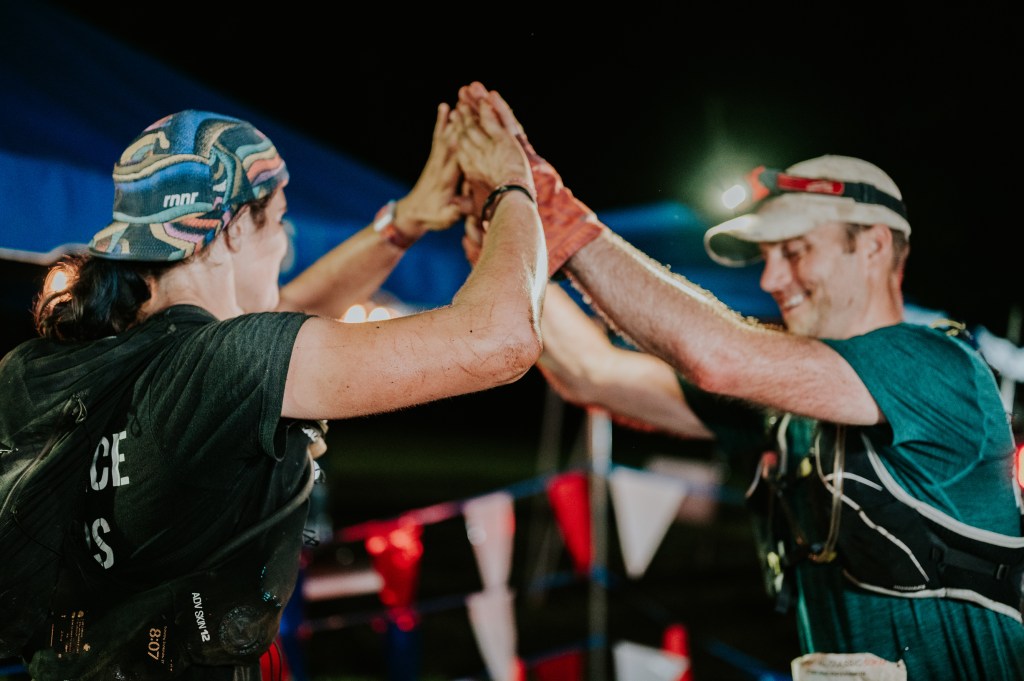
After nearly fifteen and a half hours of moving, I crossed under the finish line flag, received a high five or two, a quick congratulations, and a small group offered me some more soup.
And that was kind of it.
A rollercoaster of a day, from the highest highs and lowest lows to total stillness, with no one to truly help me process what had just happened. I spent over half a day consumed by this effort, and within minutes it felt like the world had already moved on.

Almost a year later, after stacking a handful of races at different distances, I lined up for the Tejon Ranch 100K. This race felt different. I knew I could cover the distance. Now I wanted to learn how to race. In the end, I didn’t hit every goal, but it gave me a baseline for where I need to improve, beyond the training miles.
After seeing this video of me from mile fifty-one, my friend pointed out that I looked “more calm and joyful” than they had ever seen me at a race.
I was smiling, joking, and laughing with the incredible aid station volunteers.
The truth was that the previous ten miles had been among the hardest I’ve ever experienced. Physically, mentally, and emotionally, I was struggling. But I felt alive. I was having a blast and knew that could carry me down the mountain and to the finish line.
I would be lying if I said the final eleven miles were easy. I had been battling gut issues all day with a lack of nutrition and didn’t have any of my warm gear (both due to missed drop bags). I chose to stay present. I had put myself in this position to practice gratitude through discomfort, pain, and uncertainty.
As I rolled into the finish, I turned off my headlamp so I wouldn’t blind anyone.
Within a second, a volunteer grabbed my tracker, handed me a finisher medal, and pointed to some jugs of water. I heard a few claps from somewhere nearby. Then silence.
I filled my bottles, realized I was shivering, and stood there like a lost puppy.
I made my way to my car, changed into warm clothes, and sat with the heat blasting for a few minutes thinking, “What did I just do?” I drove ninety minutes home in the dark without ever really processing the day.
Those two finish lines have stayed with me.
So, when I volunteered at Tahoe 200, my assigned job was simple: collect runners’ trackers, direct them to pick up their medals, and take their pizza orders.
I quickly realized how many runners were crossing the finish line alone. They didn’t have any friends or family waiting for them, but I could stay.
Instead of herding them through the process, we walked together. I carried their bag with their race goodies. I helped them into the chair for their finisher photo. I poured them a Coke, water, or hot coffee. If they wanted pizza, I put the order in and picked it up when it was ready. If not, I gently encouraged them to eat when they could.
Sometimes we talked. Sometimes I asked a question because it felt like they had something they wanted to say. Sometimes we sat around the fire in complete silence. And a few times, we even all fell asleep in our chairs under the night sky. Mostly, I wanted to make sure that they knew they weren’t alone.
One runner, Tracy, crossed the finish line. I was on autopilot and extended my arms towards her. She laughed and said, “Oh… I thought you were going to give me a hug. You just want my tracker!” I immediately stopped, feeling awful, and responded, “Of course you can have a hug!” It was a small moment, but it reminded me why these moments matter. If I felt the loneliness at the end of a 16-hour day, imagine it after 4 or 5 days.


These incredible accomplishments deserve presence. It might be a pat on the back or someone helping to take your pack off. Sometimes it’s sitting quietly beside someone by the fire while they sip ginger ale. And oftentimes, it’s simply a hug.
It’s all human connection.
It reminds me of softball games and tournaments in high school. My dad always wanted to debrief after a game, but he learned that I wasn’t always ready immediately after getting in the car. He learned to give me space while still staying close. Whether it was a great game or a terrible one, he gave me the space I needed while making sure I didn’t have to process it alone.
When I look at long endurance efforts, I’ve started to appreciate that they don’t end when you cross the finish line. You spend hours and even days losing yourself and finding yourself, again and again. You are solving problems and experiencing emotions of doubt, gratitude, frustration, and joy. Then suddenly it’s over.
Endurance doesn’t require an audience; it demands connection.
The race may end at the finish line, but the experience doesn’t.
We all deserve someone to help us land.
No one should have to process it alone.


Leave a Reply